

The Bachelor's Degree in Theater Creation enables students to strengthen their creative sensibility by discovering tools that fully activate the body. Through playful and critical experimentation, students are invited to develop their own poetics.

At the University of the Arts, diverse approaches to learning and inquiry bring together research on art and arts research.

UArtes academic offerings are technologically informed, diverse, relevant, and high quality. Its higher education model in the arts is recognized both nationally and internationally.

Programs of excellence in the field of the arts that contribute to the improvement and specialization of professionals.

Find here all the information so that, once you become a member of the university community, you can be aware of its benefits.

Through our transformative management model, the university contributes to the role of arts education with vitality and relevance for society.

Art research employs diverse methods of inquiry, exploration, and knowledge generation through its own unique approaches to investigation, work, and experimentation. This process leads to original results that contribute to artistic creation

The University of the Arts is the first public institution of higher education in the arts at the national level. Learn in detail about its Transparency, Accountability, Planning and Strategic Management, and Human Resources Department.
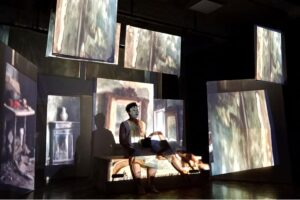
The Bachelor's Degree in Theater Creation enables students to strengthen their creative sensibility by discovering tools that fully activate the body. Through playful and critical experimentation, students are invited to develop their own poetics.
Conceived without any separation between practice and theory, the Theater Creation degree program offers students conceptual tools, techniques, and bodily practices approached from diverse ideo-aesthetic and historical perspectives—perspectives that recognize this artistic field as a space for the production of specific knowledge.
The program understands the actor as an operator, activator, and transformer of the living event that is theater. It poses a series of questions that critically examine, from a contemporary standpoint, the diverse forms of theatricality and the tradition of representation, while creating spaces for experimentation and reflection from a perspective grounded in inter, transcultural, and interdisciplinary crossings.
Graduates of the Theater Creation program are able to generate and produce theatrical events understanding theatricality as a matrix encompassing multiple variations as well as to engage in dialogue and critical reflection on the various forms of theatricality and to develop projects in, on, and for the theater. They are equipped to organize gatherings, exhibitions, seminars, colloquia, and other spaces that foster creation, circulation, and dissemination, along with diverse forms of knowledge in the field.
The School of Performing Arts brings together faculty whose sustained work in research and artistic creation whether with an emphasis on practice, theory, or both, enables the ongoing renewal of the artistic languages they work with, alongside the knowledge needed to develop a distinctive pedagogy that contributes to the transmission of performing arts knowledge. The School draws on faculty trained in historically established academic institutions as well as artists with significant careers built outside such contexts—a balance that is essential to the profile of student the program seeks to cultivate.
For more information, write to escuela.artes-escenicas@uartes.edu.ec or call (593)4-259-0700 ext 3053

Artistas escénicas formadas en la carrera de Danza, Laising Ching y Doménica Alcívar desarrollan un proyecto de obra ganador de los fondos concursables para producciones escénicas del IFAIC. Se titula “Geografías del duelo: territorios interrumpidos y cuerpos en vilo” y nace del dolor compartido por una ciudad que ha perdido su sentido de seguridad. La obra se estrenará los días 17, 18 y 19 de julio en Teatro Casa Zona Escena.

El Plan de Movilidad Nacional permite estancias temporales de estudio en otras universidades. La UArtes inició el intercambio académico con la Espol en el 2022-B y actualmente lo realiza también con la Universidad Católica, Casa Grande y Universidad del Río. Con la secretaria académica, Verónica Orellana, ampliamos el tema y conocimos la experiencia de una alumna que ha cursado materias en tres de las IES señaladas.

El reciente encuentro que la carrera de Educación Artística Intercultural propició en la Plaza Pública del MZ14 con los directores de las entidades educativas de SEIBE fue el escenario donde la alumnus Nadia Shupingahua compartió junto con las intérpretes creadoras que dirige un extracto de la obra “Secreto Matriarcal”. Su estreno será el 11 de julio en dos funciones, en Teatro Casa Zona Escena.