

The bachelor's degree in Literature teaches its students to manage the various activities in the contemporary cultural industry that revolve around texts.

At the University of the Arts, diverse modes of learning and inquiry converge both research on art and arts research.

The academic offers at the University of the Arts are technology-based, diverse, relevant, and of high quality. Its model of higher education in the arts is nationally and internationally recognized.

Programs of excellence in the field of the arts that contribute to the improvement and specialization of professionals.

Find here all the information so that, once you become a member of the university community, you can be aware of its benefits.

Through our transformative management model, the university contributes to the role of arts education with vitality and relevance for society.

Art research employs diverse methods of inquiry, exploration, and knowledge generation through its own unique approaches to investigation, work, and experimentation. This process leads to original results that contribute to artistic creation

The University of the Arts is the first public institution of higher education in the arts at the national level. Learn in detail about its Transparency, Accountability, Planning and Strategic Management, and Human Resources Department.
The bachelor's degree in Literature teaches its students to manage the various activities in the contemporary cultural industry that revolve around texts.
The Literature program at the University of the Arts provides an innovative academic space in the field of Latin American and Ecuadorian literature. It aims to train researchers, editors, creators, and literary critics who will engage in contemporary debates through the evaluation, production, editing, and management of various artistic expressions of language. This includes not only traditionally Western narratives but also stories from ancestral languages and those resulting from contemporary changes.
Graduates of the School of Literature at the University of the Arts will have, in addition to the knowledge specific to their field, a broad understanding of other artistic disciplines. As a result, they will be capable of entering the job market by executing creative projects, managing cultural activities, translating, and creating content for various communication platforms. They will also find opportunities in educational and research institutes, libraries, museums, regional and international organizations, NGOs, foundations, cultural centers, and text editing. Their broad and intercultural perspective will aim to foster social awareness and sensitivity.
The faculty of the Literature program are innovators in the field: they include writers with both artistic and academic experience; editors; and academic researchers. They are professionals with Master’s and PhD degrees, as well as specialists in ancestral languages and indigenous communities. Their research interests include Latin American literature, comparative studies, records of fantastic imagination, colonial theater, linguistic experimentation, semiotics and cultural studies, oral expressions and ancestral knowledge, bilingual intercultural education, among others.
For more information email escuela.literatura@uartes.edu.ec or call (593)4-259-0700 ext 3062

El manual de estilo de la Universidad de las Artes está ya alojado en la página web del CEAT, listo para ser descargado. No obstante, el 24 de abril se realizó su presentación impresa en la Biblioteca de las Artes con la asistencia de nuestras autoridades, docentes, estudiantes y administrativos. La obra es una herramienta que apunta a fortalecer la coherencia y la calidad en la redacción de documentos institucionales y académicos.

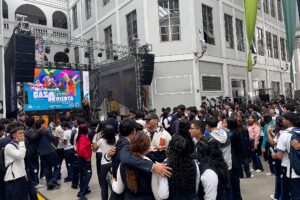
Como un espacio para el diálogo y la integración concibió la Escuela de Literatura la bienvenida que dio a sus estudiantes en el inicio del IS 2026. Junto con su directora, Solange Rodríguez, y los coordinadores de las carreras de Literatura, Siomara España, y Educación Artística Intercultural, Jorge Tigrero, los alumnos fueron recibidos por la vicerrectora académica Yulianela Pérez, rectora subrogante, y el vicerrector de Posgrados e Investigación en Artes, Andrey Astaiza.

La inauguración del fondo bibliográfico de la escritora Gilda Holst y el diálogo sobre sus obras, así como la presentación del libro “Bastard@s”, que editado por el docente Andrés Landázuri reúne ensayos sobre literatura ecuatoriana del siglo XXI, cerraron la primera jornada de la V edición de Lanfor Abierta. Organizada por la Biblioteca de las Artes, en articulación con la Escuela de Literatura, la cita celebra al libro en su día internacional.